Free
In the aisle and can’t remember the tricks?
The guide’s card, on your phone: 5 questions and 4 numbers.
5 tricks
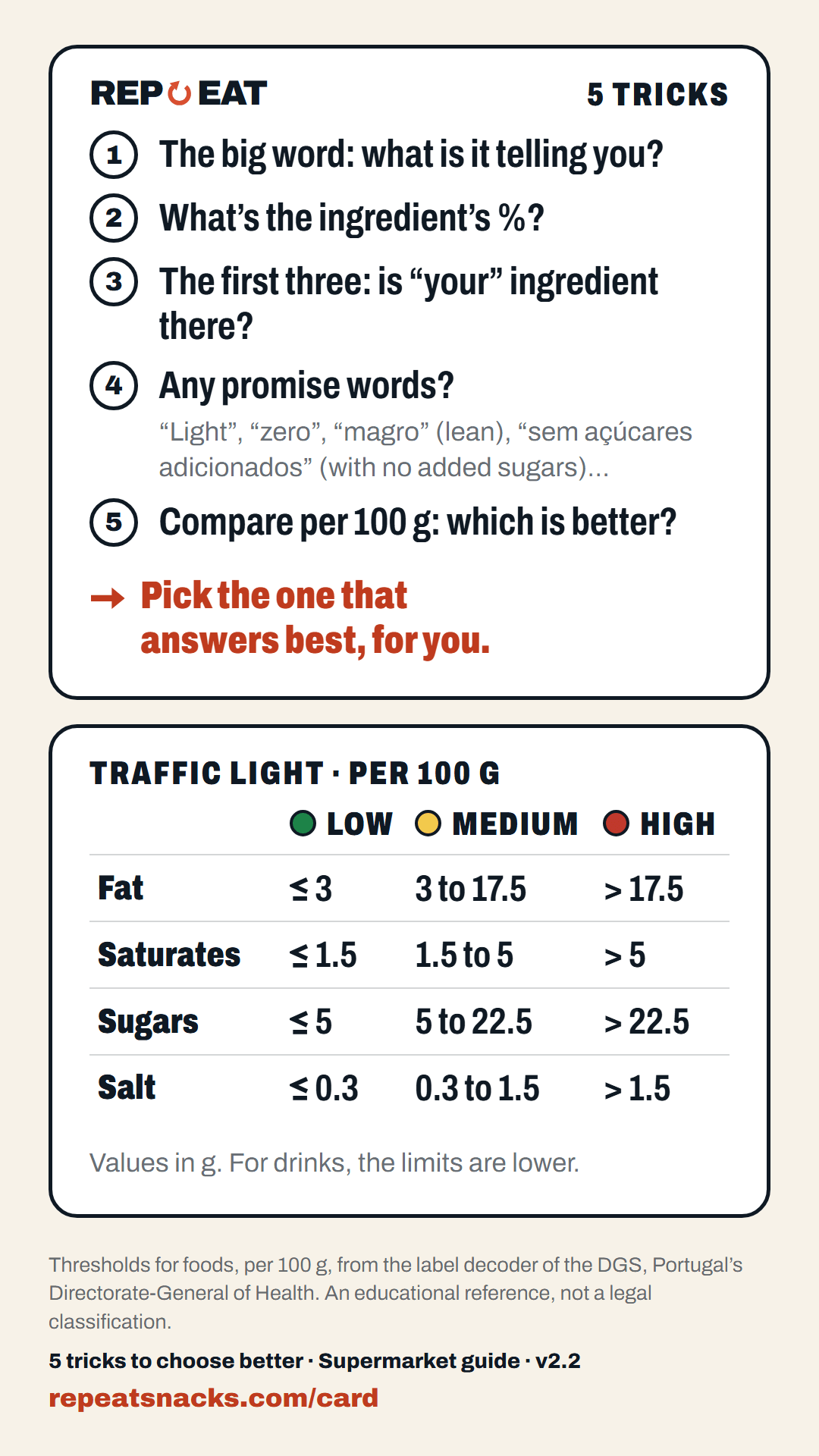
- The big word: what is it telling you? The size, the type of product, an adjective, the name or an ingredient. Trick 1
- What’s the ingredient’s %? If an ingredient caught your eye, look for its %: on the list, or next to the product name. Trick 2
- The first three: is “your” ingredient there? The first three ingredients on the list. “Yours” is the ingredient that made you pick up the pack. Trick 3
- Any promise words? “Light”, “zero”, “magro” (lean), “sem açúcares adicionados” (with no added sugars)… Trick 4
- Compare per 100 g: which is better? Traffic light? Compare the colours. No traffic light? Turn the pack over and compare the 100 g column. Trick 5
Pick the one that answers best, for you.
Traffic light · per 100 g
| Low | Medium | High | |
|---|---|---|---|
| Fat | up to 3 g | 3 to 17.5 g | more than 17.5 g |
| Saturates | up to 1.5 g | 1.5 to 5 g | more than 5 g |
| Sugars | up to 5 g | 5 to 22.5 g | more than 22.5 g |
| Salt | up to 0.3 g | 0.3 to 1.5 g | more than 1.5 g |
Values in g. For drinks, the limits are lower.
Use these answers to compare, and choose the option that best suits your needs and how often you eat it.
Thresholds for foods, per 100 g, from the “Descodificador de Rótulos” (label decoder) of the DGS, Portugal’s Directorate-General of Health. It’s an educational reference, not a legal classification. Drinks, measured per 100 ml, have lower thresholds: see the decoder on our sources page (in Portuguese).
This guide teaches you to read and compare labels. It does not say a food is good or bad, and it does not replace advice from a dietitian. The right choice depends on the product as a whole, on how much you eat, how often, and on you.
Technical content review: Sofia Beirão, nutritionist (professional registration 6154N). Guide version 2.2 (Portuguese). Sofia worked with Repeat on this guide to check the accuracy of its nutritional content.
Repeat’s news by email, in English. Sign up